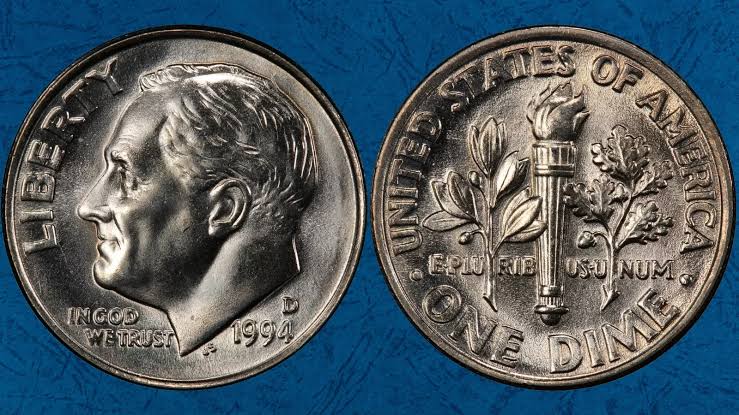
A 1994-D dime in MS-68 Full Bands condition realized $1,680 at Heritage Auctions — from a coin struck in a year when over 2.49 billion dimes rolled off U.S. Mint presses. Denver's chronic weak-strike problem made Full Bands examples nearly impossible to find, turning what looks like an ordinary ten-cent piece into one of the most sought-after conditional rarities in the modern Roosevelt dime series. Most 1994 dimes in your pocket are worth exactly face value. But if yours carries a D mint mark and something special on the torch, read on.
★★★★★ Rated 4.8/5 by 1,247 collectors
Check My 1994 Dime Value →The Full Bands designation is the single most important factor for 1994 dime value. Denver's systematic weak-strike problem means very few 1994-D dimes earned this designation — check yours now.
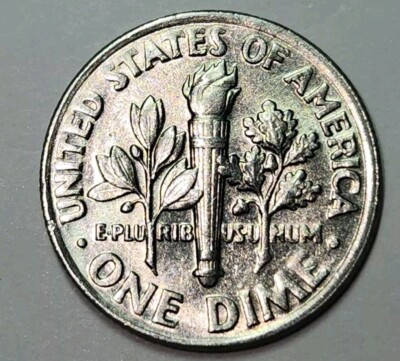
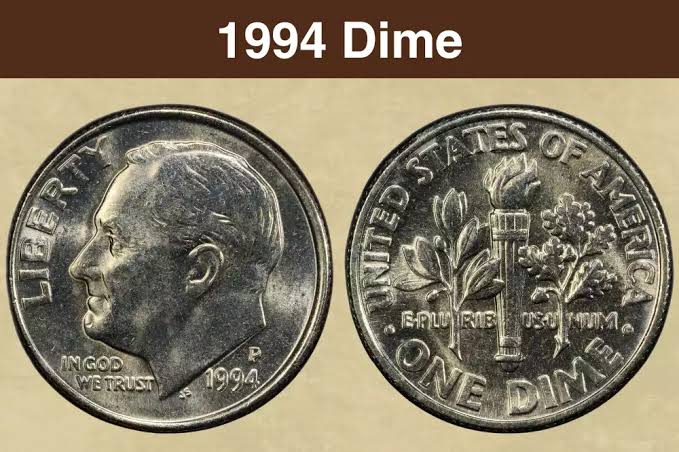
The horizontal bands on the torch appear fused or indistinct. The dividing lines between the upper or lower band pairs are interrupted, blurry, or missing entirely. This is the normal 1994-D — worth a few dollars in MS-65 and up to $250–$400 at MS-68, but no special premium.
All four horizontal bands on the reverse torch show complete, unbroken separation across the entire width. The dividing line between each pair is sharp and continuous with no gaps. This is the conditionally rare 1994-D FB — worth $300 at MS-67 and up to $1,680–$2,250 at MS-68.
Not sure what you're looking at? Describe your coin in plain language and our analyzer will give you a tailored assessment. The more detail you provide, the more precise the response.
Get a value estimate in under 60 seconds — just pick your mint mark, condition, and any errors.
Follow the three steps to get your instant value estimate. Select your mint mark first, then condition, then check any applicable errors.
Step 1: Select Your Mint Mark
Step 2: Select Condition
Step 3: Check Any Applicable Errors
If you're not yet sure of your coin's mint mark, grade, or errors, a 1994 Dime Coin Value Checker with photo upload lets you snap a photo and get an AI-powered estimate without having to know the details first.
While the 1994 dime's biggest value driver is the Full Bands conditional rarity on the Denver issue, several authentic mint errors and varieties can also command meaningful premiums. Here's everything documented for the 1994 series, ranked by collector demand and realized prices. Each entry below has been cross-checked against PCGS CoinFacts and active marketplace records.
The 1994-D Full Bands is the defining rarity of the entire year's dime production. It is not a traditional "error" but rather a conditional rarity caused by a systematic striking defect at the Denver Mint. Throughout 1994, Denver relied on dies that had been used beyond their optimal lifespan, combined with insufficient striking pressure during production runs, creating chronic weakness in the torch bands on the reverse die.
To earn the PCGS Full Bands designation, both the upper and lower pairs of horizontal bands on the reverse torch must show complete, unbroken separation across the full width of the coin. Even a single interrupted dividing line disqualifies the coin. Because Denver's dies were routinely under-performing in 1994, only a tiny fraction of the 1.3 billion coins struck that year show the required sharpness.
Collectors prize the 1994-D FB because it is the key coin of an otherwise affordable modern series. The premium over standard strikes is dramatic: at MS-67, the FB commands around $300 versus $60–$68 without it. At MS-68, the Full Bands version reached $1,680 at Heritage Auctions against $250–$400 for the standard strike — a 5–7× multiplier that makes the FB designation the most consequential single factor in 1994 dime valuation.
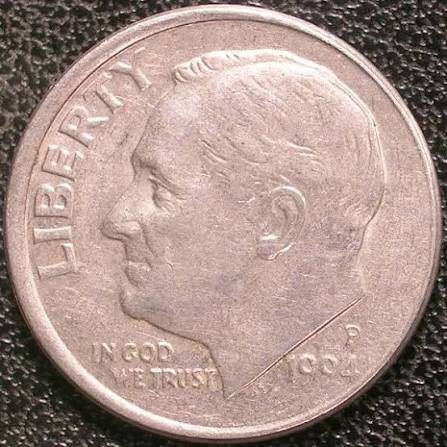
An off-center strike occurs when a dime planchet is not properly centered between the upper and lower dies at the moment of striking. Instead of receiving the impression dead-center, the blank shifts — sometimes slightly, sometimes dramatically — resulting in the design appearing skewed to one side with a blank crescent of unstruck copper-nickel planchet visible on the opposite side.
The value of an off-center 1994 dime scales directly with the percentage of displacement. Minor shifts of 5–10% add only a few dollars in collector interest. Moderate examples at 20–30% off-center command $15–$50. The most dramatic examples showing 50% or greater displacement — especially when the date remains fully visible on the shifted coin — can bring $100–$200 or more depending on how dramatic the displacement appears.
Collectors look for two features that maximize value: a large blank crescent (more dramatic appearance) and the complete date still visible despite the shift. Both the 1994-P and 1994-D can exhibit this error. Any suspected off-center error should be weighed (standard dime = 2.27g) to rule out post-mint alterations before investing in professional authentication.
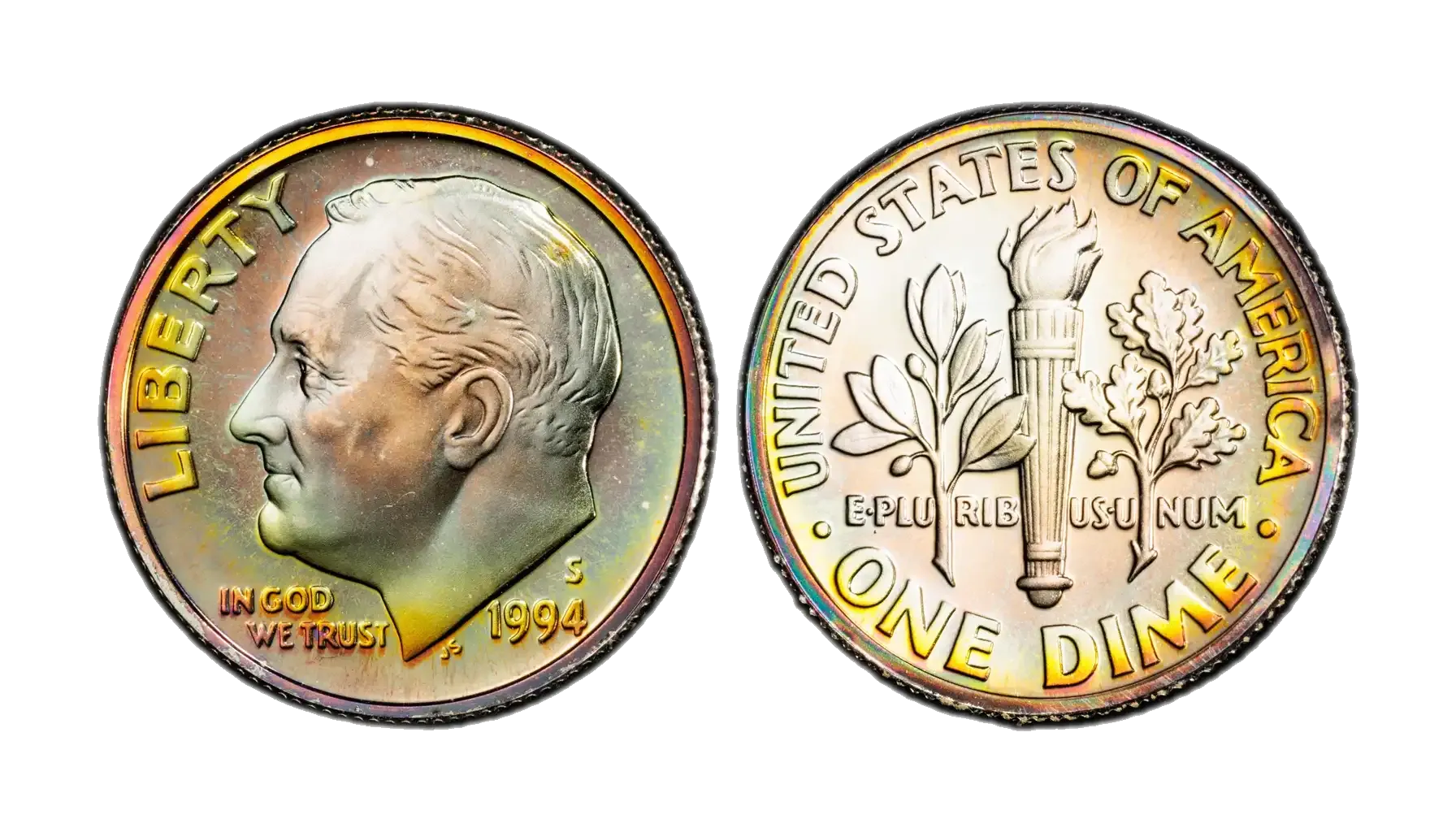
Doubled die varieties result from an improper hubbing process during die production. When a working die receives a misaligned second hub impression, the design elements are duplicated in a slightly offset position. On Roosevelt dimes, doubling is most readily visible on delicate lettering — particularly IN GOD WE TRUST, LIBERTY, the date, or E PLURIBUS UNUM on the reverse — because small letters reveal misalignment most clearly.
CONECA and Variety Vista catalog doubled die varieties for the 1994-P, 1994-D, and 1994-S. However, a critical caution applies: many online listings advertising "doubled die 1994 dimes" are actually mechanical doubling (also called machine doubling or shelf doubling), which is a worthless striking artifact that produces a shelf-like secondary image but has no collector premium. True hub doubling shows notched, rounded secondary images; mechanical doubling shows flat, shelf-like offsets.
Genuine DDO or DDR varieties on 1994 dimes that show strong, clear hub doubling on primary design elements can command premiums of $20–$650 depending on grade and strength of the doubling. Authentication by PCGS or NGC is essential before attributing any premium to a suspected doubled die — the coin-identifier.com documentation lists estimated values around $650 for the strongest examples.
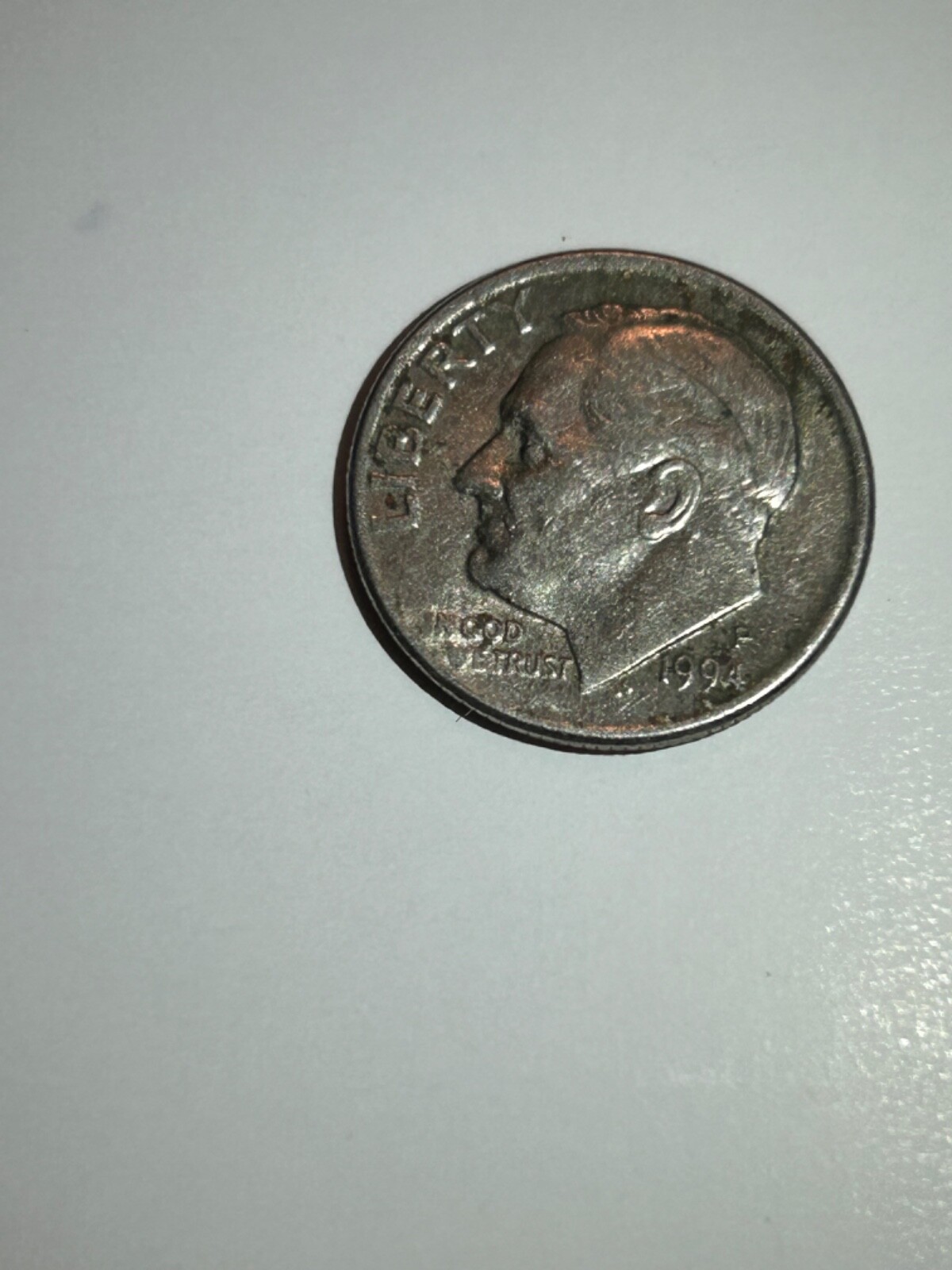
Post-1965 Roosevelt dimes are struck on copper-nickel clad copper planchets — a copper core with a nickel-copper alloy bonded to each face. The missing clad layer error occurs when a planchet arrives at the press with one face already delaminated or when the bonding process failed during manufacture, leaving one side of the struck coin showing the bare copper core rather than the normal gray-nickel surface.
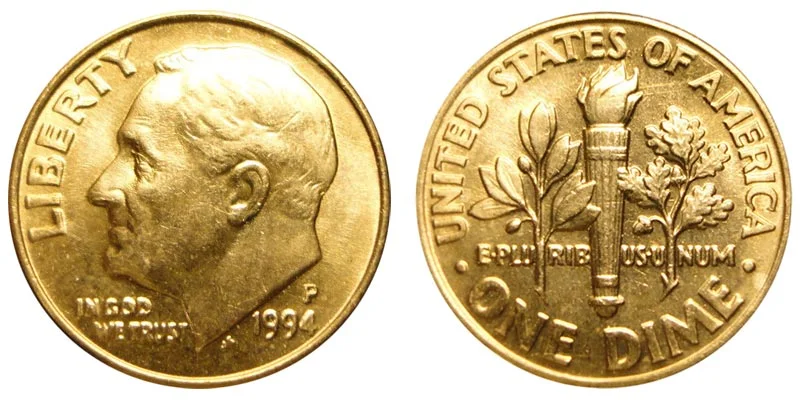
A missing clad layer 1994 dime is immediately recognizable: one side appears the normal silver-gray color, while the affected side shows unmistakable copper-orange or reddish-brown toning typical of the coin's copper core. The design strikes normally on both sides — the missing clad layer is a planchet defect, not a strike defect. Coins with a complete obverse missing clad layer are slightly more popular with collectors than reverse-missing examples.
These errors pass quality control at the mint far less frequently than minor die errors, making genuine certified examples considerably scarcer. Value depends on how completely the clad layer is absent (full missing layer versus partial delamination), the affected side, and the grade of the underlying strike. A fully certified example from PCGS or NGC in attractive condition can bring $75–$400 at major auction venues.
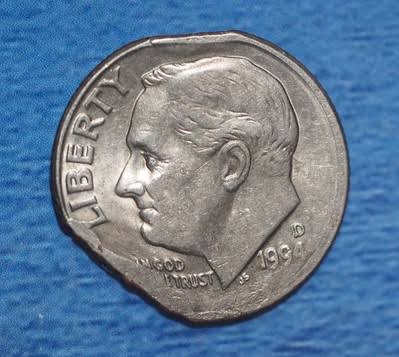
A clipped planchet error occurs during the blanking process, when the machine that punches circular dime blanks from a long metal strip accidentally punches a new blank from a position that overlaps an area where a previous blank was already removed. The resulting blank has a curved "bite" taken out of it — a curved clip — or occasionally a straight clip if the overlap occurs at the very end of the strip.
When a clipped planchet is struck between the dies, the coin's design is fully impressed on the remaining metal, but the missing portion creates a notched edge with a corresponding weakness in the nearby design detail. On the opposite side from the clip, the Blakesley Effect causes the rim and lettering to appear weak or missing, providing a useful diagnostic to confirm authenticity. Coin-identifier.com documents three types for the 1994 series: curved clips (most common), straight clips, and ragged clips.
While clipped planchets are among the more accessible error coins for beginning collectors — they can occasionally appear in circulation — they still represent genuine mint production anomalies that passed quality control. Value increases with the size of the clip (larger percentage of missing metal), with dramatic multi-clip examples or complete date visibility commanding the highest premiums. Collector appeal has kept documented examples of this error in consistent demand.
Run the calculator to get an instant value estimate based on your specific mint mark, grade, and error combination.
For a thorough step-by-step 1994 dime identification walkthrough with complete grading reference images, see this detailed 1994 Roosevelt dime recognition and value guide. The table below summarizes current market ranges based on PCGS Price Guide and Heritage Auctions records.
| Variety | Worn / Circulated | About Unc. (AU) | Unc. (MS-65–66) | Gem (MS-67–68+) |
|---|---|---|---|---|
| 1994-P (Philadelphia) | $0.10 | $0.15–$1 | $7–$15 | $30–$160 |
| 1994-P Full Bands | $0.60–$1 | $3–$5 | $7–$115 | $185–$1,080 |
| ⭐ 1994-D Full Bands (KEY COIN) | $0.30–$0.35 | $1–$2 | $45–$115 | $300–$2,250 |
| 1994-D (Denver) | $0.10 | $0.15–$1 | $12–$40 | $60–$400 |
| 1994-S Clad Proof | N/A | N/A | $3–$8 | $8–$16 |
| 🔴 1994-S Silver Proof (RAREST) | N/A | N/A | $6–$20 | $20–$88+ |
Values based on PCGS Price Guide and Heritage Auctions records · 2026 edition. The 1994-D FB row is highlighted in gold; the 1994-S Silver Proof row is highlighted for its rarity.
📱 CoinKnow gives you a fast on-the-go estimate for any Roosevelt dime — snap a photo and cross-check the grade against your own assessment — a coin identifier and value app.
The 1994 Roosevelt dime series was produced at extraordinarily high volumes. Despite this, gem-quality survivors with special designations are far scarcer than the raw mintage suggests — most of those 2.49 billion coins circulated heavily and survive only in worn, low-value condition.
| Mint | Mint Mark | Mintage | Composition | Finish |
|---|---|---|---|---|
| Philadelphia | P | 1,189,000,000 | 75% Cu / 25% Ni clad over Cu core | Business Strike |
| Denver | D | 1,303,268,110 | 75% Cu / 25% Ni clad over Cu core | Business Strike |
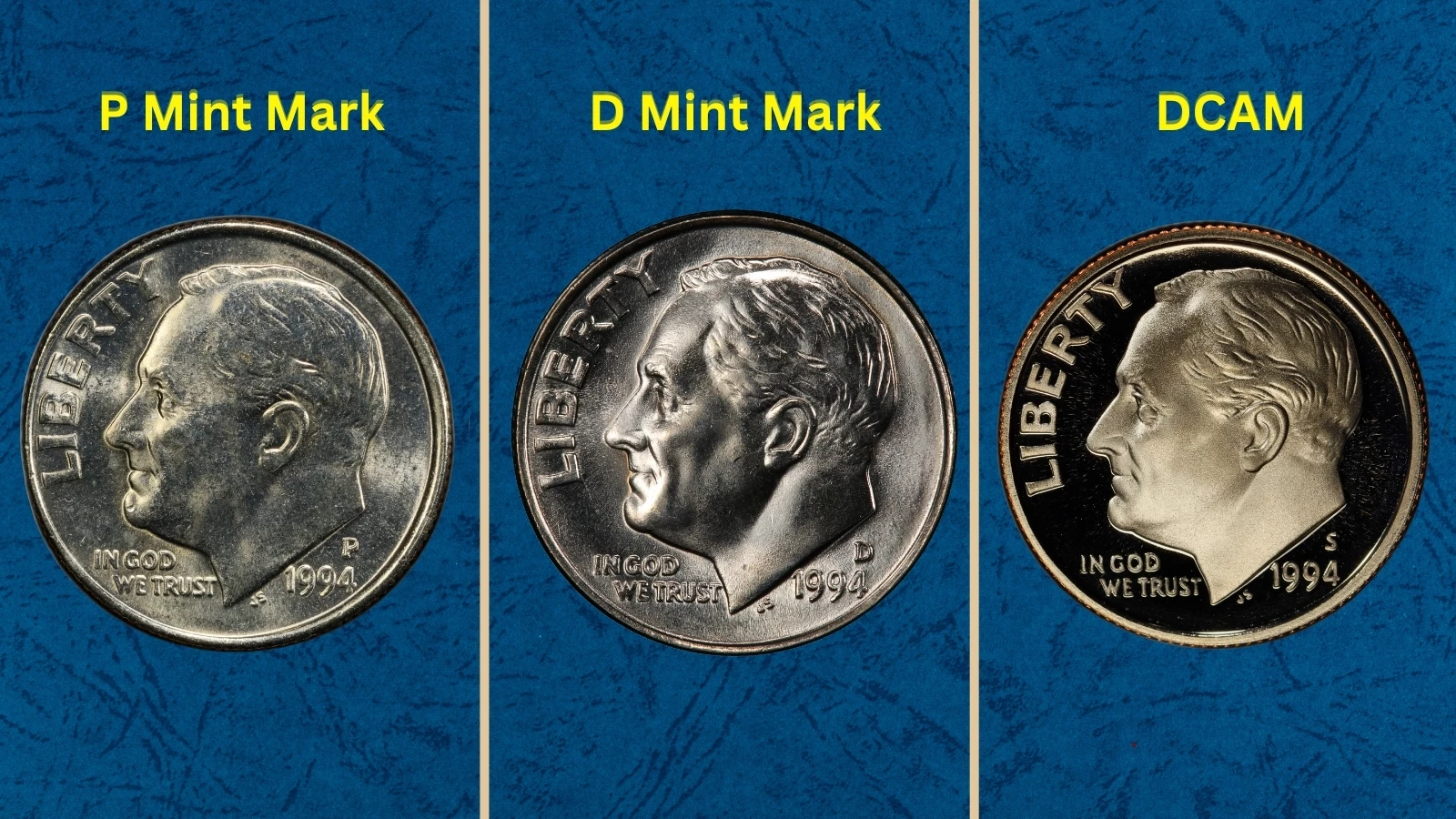
| San Francisco | S | 2,484,594 | 75% Cu / 25% Ni clad over Cu core | Proof (DCAM) |
| San Francisco | S | 785,329 | 90% Silver / 10% Copper | Silver Proof (DCAM) |
| Total | 2,495,537,033 | — | ||
Accurate grading is the second most important step after identifying the mint mark. For 1994 dimes, grade determines whether you're looking at face value or real collector money.
Roosevelt's portrait shows heavy flattening on the cheek and jaw. Hair detail is mostly gone. The torch flames and bands are completely flat. Lettering is readable but well-worn. These coins are worth exactly $0.10 face value — the 2.49 billion minted means worn examples are extremely common.
Moderate to light wear on Roosevelt's cheekbone and the high points of the hair. The torch and bands show some detail but no sharpness. About Uncirculated examples retain most of the original luster with only the slightest rub on the cheek and hair. Value remains near face value for all 1994 circulated dimes.
No wear whatsoever — original mint luster present across all surfaces. Cartwheel luster effect visible when tilted under light. Contact marks from bag or roll storage reduce grades in this range. MS-65 examples are worth $7–$18 for the Philadelphia and Denver issues; MS-66 gems bring $28–$40.
Full unbroken luster, minimal contact marks, strong strike. At MS-67, value reaches $30–$68 for standard strikes; Full Bands examples at this grade bring $300 (D) or $40–$80 (P). MS-68 is exceedingly rare — the 1994-D standard MS-68 brings $250–$400, while MS-68 FB is the $1,680–$2,250 key coin.
🔍 CoinKnow helps you compare your dime's surface against graded reference examples to match the right condition tier before deciding whether professional grading is worth the cost — a coin identifier and value app.
The right venue depends on your coin's value tier. A worn circulated dime has essentially no secondary market. A certified 1994-D MS-67 FB is a different story entirely.
The premier venue for any 1994 dime grading MS-67 or above, or any Full Bands example at MS-66+. Heritage has handled the key auction records for this series — including the $1,680 MS-68 FB sale. Their Roosevelt dime collector base is deep and competitive, ensuring maximum realized prices for top-tier examples. Minimum auction consignment thresholds apply.
The most practical venue for mid-tier 1994 dimes — uncirculated P and D examples grading MS-65 to MS-66, error coins under $100, or raw (ungraded) coins you've found in rolls. Check actual 1994-D sold prices and completed listings on eBay to set realistic price expectations before listing. Sold listings give far more reliable data than current asking prices.
Best for quick liquidity on lower-value coins. Dealers will typically offer 50–60% of retail for common-date Roosevelt dimes. For a potential 1994-D Full Bands example, bring it to a knowledgeable dealer for a second opinion before committing to any sale — they can often spot grade-limiting factors that might not be obvious to a new collector.
A free peer-to-peer platform popular for mid-range coins where eBay fees would eat too much of the profit. The Roosevelt dime collector community is active on Reddit. Transactions should be conducted with established users with positive feedback history; always ship with tracking and insurance for any coin worth over $20.
Most 1994 dimes in circulated condition are worth exactly face value — $0.10. Value increases significantly in uncirculated grades: MS-65 examples fetch $7–$18, and MS-67 pieces can bring $30–$68. The standout is the 1994-D Full Bands, where MS-67 FB examples sell for around $300 and MS-68 FB coins have realized $1,680 at Heritage Auctions. Silver proofs carry a minimum melt value around $3.50.
The Denver Mint experienced a systematic weak-strike problem in 1994, likely from dies used beyond optimal lifespan or insufficient striking pressure. This made Full Bands examples — where the horizontal torch bands show complete separation — exceptionally scarce. At MS-67, a 1994-D FB commands around $300 versus about $40–$60 for the Philadelphia equivalent. At MS-68 FB, the premium climbs to $1,680–$2,250, making it the series' key conditional rarity.
Full Bands is a PCGS designation confirming exceptional strike quality on the reverse torch. To qualify, both the upper and lower pairs of horizontal bands must show complete separation with unbroken dividing lines across the entire width. For the 1994-D, the Denver Mint's chronic weak strikes made Full Bands examples extremely rare, which is why they command a premium of 5–7 times the standard strike value at equivalent grades.
The U.S. Mint produced approximately 2.49 billion business-strike 1994 dimes. Philadelphia struck 1,189,000,000 and Denver struck 1,303,268,110. San Francisco produced 2,484,594 clad proof dimes and 785,329 silver proof dimes, both sold exclusively to collectors. The sheer production volume makes circulated examples essentially worthless above face value.
Regular 1994 dimes (P and D mint marks) are not silver — they are copper-nickel clad copper, consisting of 75% copper and 25% nickel bonded to a pure copper core. The only silver 1994 dimes are the 1994-S Silver Proof dimes from San Francisco, which are 90% silver and were sold only in special proof sets to collectors. You can identify proof coins by their mirror-like fields and frosted designs.
Documented errors for 1994 dimes include off-center strikes (minor examples worth a few dollars; dramatic 50%+ shifts can reach $100+), clipped planchet errors, missing clad layer errors, broadstrike errors, die crack errors, struck-through errors, and doubled die obverse/reverse varieties. The most significant hypothetical error is a dime struck on a cent planchet, which in certified form would be worth considerably more. Most errors must be verified by PCGS or NGC.
On a 1994 Roosevelt dime, the mint mark is located on the obverse (front) below the truncation of Roosevelt's neck portrait, to the right, just above the date. Philadelphia coins bear a small 'P,' Denver coins show a 'D,' and San Francisco proof coins carry an 'S.' All three mint marks are the same small size and require good lighting or a loupe to read clearly.
Never clean a coin you intend to sell or have graded. Cleaning destroys the original mint luster and surface texture that grading services use to assign grades and detect problems. A cleaned coin is typically designated 'details' by PCGS and NGC, significantly reducing its value and marketability. Even a light wipe with a cloth can create hairline scratches visible under magnification, permanently reducing the grade and premium value of the coin.
The 1994-S Silver Proof dime, struck in 90% silver at San Francisco with a mintage of 785,329, carries a base melt value around $3.50 and typically trades between $6–$35 depending on grade. Deep Cameo (DCAM) examples with mirror fields and sharp frosted designs command higher premiums. The top auction record for a PR-70 example reached $719 at Heritage Auctions.
Professional grading by PCGS or NGC makes economic sense only when potential value exceeds the $30–$50 minimum certification fee. This threshold is met for any 1994-D that appears to have Full Bands torch detail, any example that grades MS-67 or higher, or a 1994-S Silver Proof in apparent PR-70 DCAM. For ordinary circulated 1994 dimes or low-grade uncirculated pieces, grading costs will exceed the coin's market value.